
11.25.2026
How to Become a Dance Teacher in Texas

You know how to turn a room of beginners into a group that moves as one. You have counted the eights, fixed the same turn a dozen times and watched a combination finally click. In Texas, you can bring that work into a public school classroom, even without an education degree.
Here is the short version. To teach dance in a Texas public school, you need a bachelor’s degree, the Dance: Grades 6-12 certificate, and passing scores on the TExES Dance 6-12 (279) exam and the Pedagogy and Professional Responsibilities (160) exam. If you already have a degree, Texas offers an alternative certification route, so you can build on the experience you have instead of starting over.
This guide walks you through each step: what the certificate covers, what’s on the exam, how the alternative route works, how long it takes, what it costs and what dance teachers in Texas earn.
What Does a Dance Teacher Do in Texas Public Schools?

A Texas dance teacher does much more than lead warm-ups and teach combinations. Dance is one of the four fine arts in the Texas Essential Knowledge and Skills (TEKS) for Fine Arts, with dance standards for grades 6 through 12. In practice, you would teach Dance, Middle School 1, 2 and 3 in the middle grades and Dance, Level I through Level IV in high school.
The standards treat dance as a full art form. They cover perception, creative expression, historical and cultural relevance, and critical evaluation and response. As a dance teacher in a Texas public school, you help students create their own work, learn where different dance forms come from and talk about the art form they are working to master.
Interested in teaching another performance-based subject? Read our guides on how to become a speech and debate teacher in Texas and how to become a technology applications teacher in Texas.
What Is Dance Teacher Certification in Texas?
The Dance: Grades 6-12 certificate qualifies you to teach dance in both middle school and high school. Dance teacher certification in Texas is a standard classroom teaching certificate, the same kind of credential teachers of other subjects hold.
You need to pass two exams for this certificate:
- TExES Dance 6-12 (279): the content exam, which tests what you know about dance.
- Pedagogy and Professional Responsibilities EC-12 (160): the PPR exam, which tests how you teach.
One change is coming. TEA is developing the Texas Test of Educator Proficiency (T-TEP), a performance-based assessment planned to launch as the required pedagogy assessment in September 2027, pending State Board for Educator Certification (SBEC) action. Until then, the PPR is the pedagogy exam most candidates take. Your program will tell you which one applies to you.
You earn the certificate by completing an approved educator preparation program. The next sections explain the exam and how to get into a program.
What Is the TExES Dance 6-12 (279) Exam?
According to the official exam framework, the 279 is a computer-administered test with 100 selected-response questions and a five-hour time limit. It measures whether you have the knowledge and skills an entry-level dance teacher in a Texas public school needs.
The questions fall into four domains:
| Domain | Share of the exam |
|---|---|
| I. Dance Elements and Skills | about 41% |
| II. Dance Creation and Production | about 18% |
| III. Dance Culture, History and Analysis | about 18% |
| IV. Dance Education | about 23% |
The largest share goes to dance elements and skills, the area where your own training and performance experience helps most. The other three domains ask you to think like a teacher and a student of the art form, including choreography, production, dance history and how to teach and assess students.
TExES exams are scored on a scale from 100 to 300, and you need a scaled score of 240 to pass.
How to Prepare for the TExES Dance 279
- Start with the free preparation manual. The Dance 6-12 preparation manual lists every competency and includes sample questions with explanations.
- Study your weakest domain first. Experienced dancers often need the most review in dance history and cultural context, and in Dance Education.
- Brush up on vocabulary. Know the terms for elements such as space, time and energy, plus kinesiology, injury prevention and the vocabulary of major dance forms.
- Take a timed practice test. Five hours is a long session, so practice your pacing before test day.
Can You Become a Dance Teacher Without an Education Degree?
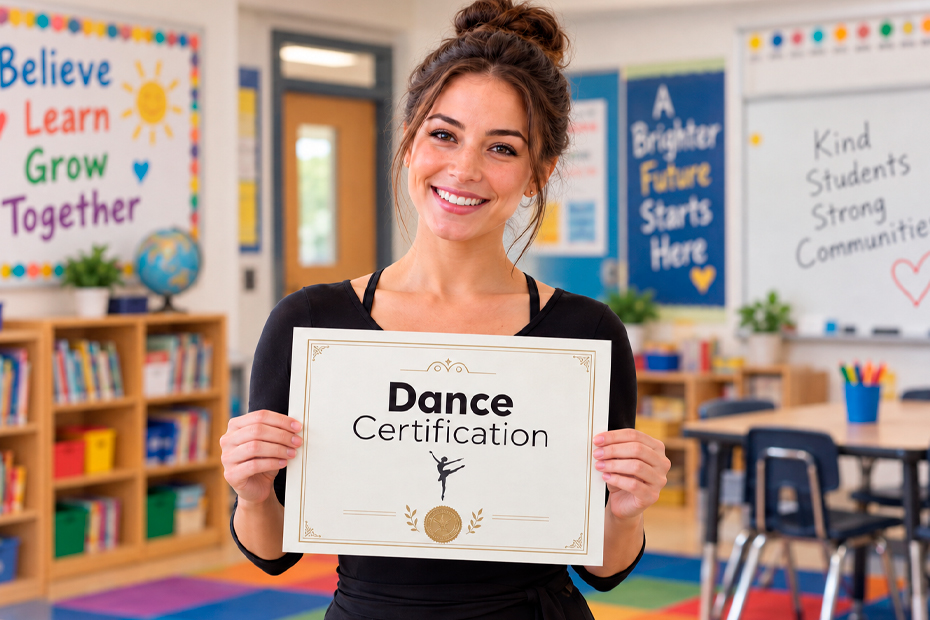
Yes. The alternative route is built for people who already have a degree. TEA describes alternative certification programs (ACPs) as a nontraditional route that may let you teach while you complete the requirements. Each program can also set requirements of its own beyond the state’s.
The state admission rules (19 TAC §227.10) set the minimum. Here’s how the path works:
- Hold a bachelor’s degree. It must come from an accredited college or university, and it doesn’t have to be in education or dance.
- Meet the GPA requirement. You need a GPA of at least 2.5, measured across your whole degree or across your last 60 semester credit hours.
- Show that you know dance. Your program checks your transcript for at least 12 semester credit hours of dance coursework. If you don’t have them, you can pass the TX PACT: Dance: Grades 6-12 (779) to show your content knowledge instead.
- Complete the program’s training. This means the coursework and classroom preparation your program requires.
- Pass the 279 and the PPR, then apply for your certificate.
Keep in mind that the PACT is only an admission test. You still have to pass the 279 to earn the certificate.
If you’re a working dancer, choreographer or studio instructor with a degree in another field, these steps let you build on what you already know.
How Long Does It Take to Become a Dance Teacher in Texas?
If you already have a bachelor’s degree, you can usually become certified in about a year. TEA notes that many alternative certification programs can be finished in one year, and you may be able to teach as a paid intern during that time, with supervision and mentoring.
Your timeline depends on how quickly you finish coursework, when you pass your exams and when a school hires you. Self-paced online programs let you move faster if you have the time.
How Much Does Dance Teacher Certification Cost?
Your total cost includes your program fees plus state fees. Plan for these state costs:
- TExES exams: most cost $116 per attempt, so the 279 and the PPR together usually come to about $232.
- State certification application: TEA lists the certification application fee at $78.
- TX PACT (if needed): a separate fee, payable only if you use the PACT to qualify for admission.
- Fingerprinting: required for all new Texas educators.
For program costs and payment options, see TeacherBuilder.com pricing.
Where Do Texas Schools Hire Dance Teachers?
Dance teachers work in middle schools and high schools, where the state’s dance standards apply. In Texas, both public school districts and open-enrollment charter schools hire teachers, so check both.
State graduation rules help keep dance classes in demand. According to TEA’s fine arts FAQ, high school students need one fine arts credit to graduate under the Foundation High School Program, and middle school students must complete one fine arts course in grade 6, 7 or 8. A dance class is one way students meet those requirements. TEA’s physical education FAQ also lets a student in Middle School Dance 1-3 earn fine arts credit and meet the middle school PE curriculum requirement in the same class, which makes dance appealing to campuses.
To find openings, start with TEA’s Texas Educator Job Sites page. It links to the Texas Association of School Administrators career center and to the job boards of all 20 regional education service centers. You can also browse Texas teaching jobs on TeacherBuilder.com. Search for dance and fine arts roles. Postings usually name the certificate they require, so check that Dance: Grades 6-12 is the one listed.
How Much Do Dance Teachers Make in Texas?

In Texas public schools, dance teachers are paid on the same salary schedule as other classroom teachers. TEA reported an average Texas teacher salary of about $68,000 for the 2025-26 school year, and a statewide salary survey by the Texas Association of School Boards found a median starting salary of $50,000.
Texas sets a state minimum salary schedule under Texas Education Code Section 21.402, based on years of experience, and districts can pay more than the minimum. Each district publishes its own salary schedule, so the most useful figure is the one from the district where you want to work.
Pay also rises with experience. House Bill 2, passed in 2025, created the Teacher Retention Allotment, which funds raises for classroom teachers with at least three years of experience. In districts with 5,000 or fewer students, the allotment provides $4,000 per teacher with three or four years of experience and $8,000 per teacher with five or more. In larger districts, it provides $2,500 and $5,000.
Ready to Turn Your Dance Experience Into a Teaching Career?
Now you have the roadmap, and the next step is a small one. TeacherBuilder.com is an online alternative teacher certification program in Texas, accredited by SBEC and TEA. It’s the kind of educator preparation program described above, built for people who already have a degree and want to teach.
Here’s how it works if you’re a dancer or dance instructor:
- Check that you qualify. You need a bachelor’s degree, or to be in the last semester of one, and a GPA of at least 2.5 overall or in your last 60 semester credit hours. See the full admission requirements.
- Apply and send your transcripts. Start your application online, then send your official transcripts for review.
- Choose Dance: Grades 6-12 and enroll. TeacherBuilder.com offers several certification routes, including PACT. Take the Route Finder quiz to see which one fits you.
- Study on your own schedule. The coursework is 100% online and self-paced, so you can keep teaching classes or working while you train.
- Pass your exams. For Dance: Grades 6-12, that means the 279 and the PPR.
- Start applying for teaching jobs. You can apply while you finish the remaining state requirements, and the program supports you through your first year of teaching. If a district hires you as an intern, that internship is a paid year in your own classroom.
Not sure which exams your certification area requires? The TeacherBuilder.com exam matrix lists the TExES exams for every area. Find Dance: Grades 6-12 there to confirm that you need the 279 and the 160, and to see exactly what stands between you and your certificate.
Apply to TeacherBuilder.com today and bring your love of dance to a Texas classroom.
Frequently Asked Questions About Becoming a Dance Teacher in Texas
Do I need a dance degree to teach dance in Texas?
No. You need a bachelor’s degree in any field, plus at least 12 semester credit hours of dance coursework or a passing score on the TX PACT for Dance: Grades 6-12. After that, you complete an educator preparation program and pass the required exams.
What grades can I teach with a Texas dance certificate?
The Dance: Grades 6-12 certificate covers middle school and high school dance, from Dance, Middle School 1 through Dance, Level IV.
What score do I need to pass the TExES Dance 6-12 exam?
You need a scaled score of at least 240 on a scale of 100 to 300.
Can I teach dance while I get certified?
Often, yes. Through an alternative certification program, you may be able to teach as a paid intern on an intern certificate once you’ve met the program’s requirements and a district hires you.
Do I need a certificate to teach at a private dance studio?
No. Texas teaching certificates are required for public school classrooms, not private studios. You do need the Dance: Grades 6-12 certificate to teach dance in a Texas public school.
How many times can I take the TExES Dance exam?
Texas allows five attempts at each certification exam. After that, you have to request a waiver to test again.
This post is for general information and is not legal, educational or government advice. Requirements and fees can change, so confirm current rules with the Texas Education Agency.